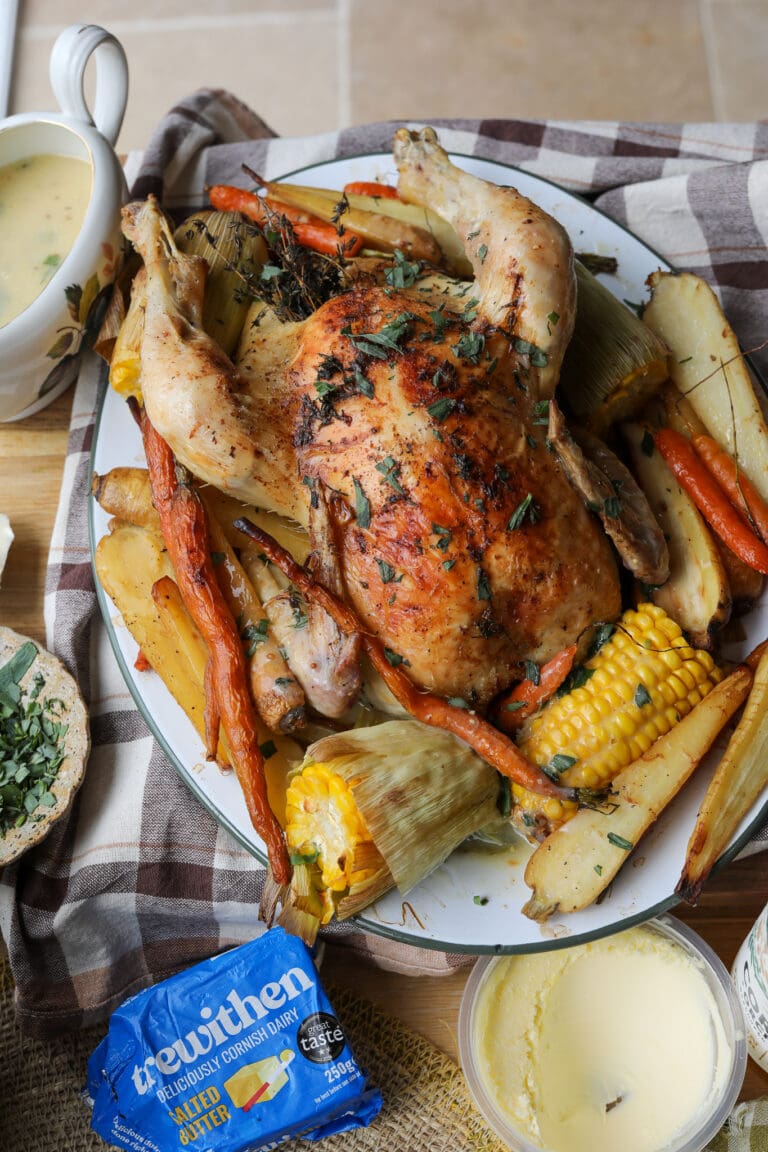
Roast Chicken with Cider & Cornish Clotted Cream Gravy
Serves 4-6
Trewithen Dairy is now Cornish Dairy Co!
Our unsalted butter is pure, creamy and made simply; just Cornish cream, churned slowly with nothing else added. Whether you’re creaming it into a Victoria sponge, rubbing it into pastry, or melting it for a sauce, unsalted butter is a natural choice for baking. It’s just as good spread on warm toast or stirred through veggies, with a clean, rich flavour that lets whatever you’re making shine through.
Unsalted butter is butter in its simplest form – Cornish Cream that’s been churned until it separates from the buttermilk, and nothing added afterwards.
That simplicity gives you the true character of the cream itself: a rich, buttercup-yellow colour and a full, rounded taste, with complete control to season it however a recipe calls for. Unsalted butter is a staple across British kitchens, and as a Cornish dairy product, ours carries that same rich, creamy quality through to the finished block. It’s smooth enough to spread, and reliable enough to bake with every time.
It’s the farmers as much as the county. We know every one of ours personally, and each supplies milk from dairy herds raised right here in Cornwall – all within a 25-mile radius of our dairy in Lostwithiel. That relationship means we can hold every farm to the same high standards for animal welfare, and it’s what gives this butter its distinctly Cornish character, batch after batch.
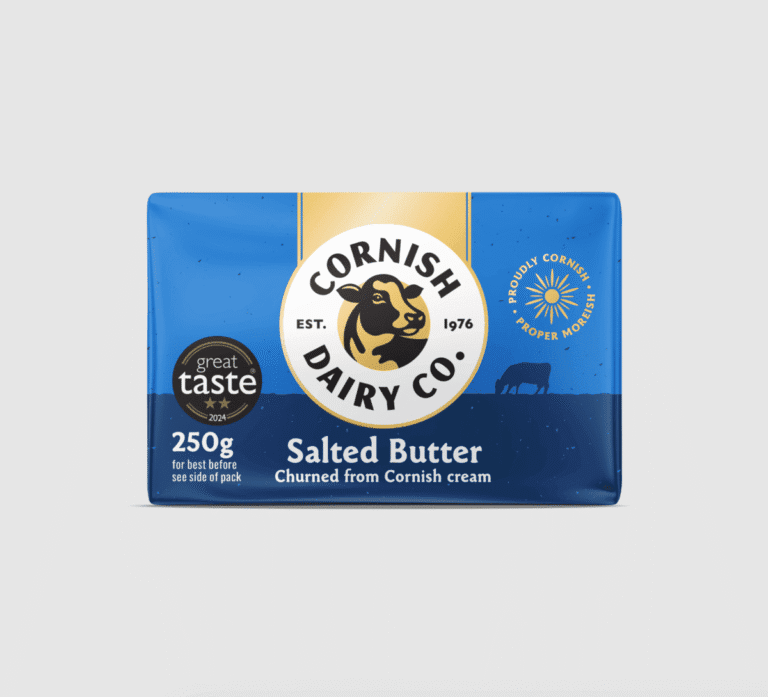
Our best salted butter has been recognised with a 2-star Great Taste Award, one of the food industry’s most respected marks of quality, and it’s made using the same Cornish cream and traditional methods as our unsalted butter. While our unsalted version hasn’t been entered for its own award (yet!), it carries that same award-winning quality in every batch.
Cornish butter begins with cream from Cornish herds, brought in fresh while the quality’s at its peak. From there, it’s churned patiently until the buttermilk separates away, leaving thick, smooth and unmistakably golden Cornish butter. Nothing else goes in, no salt, no shortcuts, just cream given the time it needs to become something good. It’s a simple process, done properly, and it’s why the butter tastes the way it should.
Typical values per 100g:
Energy 3181KJ/774kcal
Fat 85g
of which saturates 54g
Carbohydrate 1.4g
of which sugars 0.4g
Protein 0.6g
Salt 0.03g
Minimum fat content: 80%
Ingredients: Butter (cows milk)
Available sizes: 250g
Keep Refrigerated below 5C
Our unsalted butter is stocked at Tesco, Asda, & Ocado, sitting alongside the rest of the Cornish Dairy Co range in the chilled section.
Check out more on where to find us here.
A 250g block of our Cornish unsalted butter typically costs around £3.00. Prices can vary slightly by retailer and are subject to change, so it’s worth checking with your local store for the latest price.

Unsalted butter really earns its keep at the baking bench. Cream it with sugar for a light, airy sponge, rub it into flour for shortcrust pastry, or use it to laminate dough for flaky croissants and puff pastry – all with full control over the salt in the finished bake. It’s just as useful in savoury cooking: whisk it into a beurre blanc, finish a risotto for extra silkiness, or use it as the base for a compound butter with herbs and garlic. For something simpler, it’s lovely spread on warm toast or melted through new potatoes, letting the clean, creamy flavour speak for itself.

Good butter starts long before it reaches the churn – it starts with how the cows are looked after. Our farmers are based right here in Cornwall, close enough that we know them by name (not just by their farm’s supply number!) and we hold every one of them to the same high standards for animal welfare and husbandry. That care shows up in the quality of the cream, and in turn, in every block of Cornish unsalted butter we make. It’s not just about the end product – it’s about doing right by the land and the animals that make it possible, so both are still thriving for the next generation of Cornish dairy farmers.

Discover our other delicious Cornish Dairy Co products.
For cafés, restaurants and retailers looking to stock Cornish salted butter, our trade team can set up regular deliveries by post to suit your business. Get in touch with our wholesale team on 01208 228700 or hello@ehrmann.co.uk to discuss volumes, pricing and delivery, or visit our Trade & Wholesale page for more information.
Learn more about our Cornish Dairy Co standards and delicious products.
Both salted butter and unsalted butter can be used interchangeably in any recipe, but if the recipe calls specifically for unsalted butter, it’s probably because the recipe has been tested with it and is preferred for that particular recipe. If you only have salted butter, you can reduce the recipe’s salt by about half when substituting. You can add about 1/4 teaspoon of salt per half cup of butter to convert unsalted butter to salted.
Because salt is a preservative, salted butter tends to last longer than unsalted butter. However, the amount of salt in salted butter isn’t standardized, so it varies across brands and can even vary from batch to batch within the same brand.
Generally, you should use unsalted butter. You can always add salt to your unsalted butter, but you can’t take it out if you want it less salty!
Neither is “better” – they’re suited to different jobs. Unsalted butter gives you full control over salt levels, which is why it’s preferred for baking, while salted butter (often just called “butter”) is the more common everyday choice for spreading and general cooking.
“Regular” butter usually refers to salted butter, which has a small amount of salt (around 1.5–1.8%) added during production. Unsalted butter skips that step entirely – it’s just churned cream, nothing else.
Unsalted and salted butter are nutritionally almost identical in fat and calories – the main difference is sodium. Unsalted butter contains virtually no added salt, which can suit those managing their sodium intake, but neither is “healthier” in terms of fat content.
Unsalted butter is most often used in baking, where precise control over salt matters – think sponges, pastry and shortbread. It’s equally good in cooking, from finishing sauces to spreading on toast.
Look for a butter with a high fat content (80%+) and a simple ingredients list of just cream – this gives the most consistent, controllable results in baking. Our Cornish unsalted butter fits that description; churned from Cornish cream with nothing else added.
Phone, email, social media, or even a good old letter. We are happy to hear from you.